
AMD FSR “Redstone” is the codename for AMD’s next-generation suite of graphics technologies. It represents a fundamental change in how AMD approaches game performance. For the first time, AMD is abandoning its “software-only” philosophy to compete directly with Nvidia’s Deep Learning Super Sampling (DLSS).
Table of Contents:
From Analytical Upscaling to Machine Learning
The defining characteristic of Redstone is the switch from Analytical Upscaling to AI-Based Reconstruction.
- The Old Way (FSR 1, 2, & 3): These versions used hand-written mathematical algorithms. The benefit was broad compatibility (they worked on almost any GPU, including Nvidia and Intel cards), but they eventually hit a “quality ceiling” where the image couldn’t get any sharper without artifacts.
- The Redstone Way: This uses neural networks trained on massive datasets of game footage. The AI “hallucinates” missing details to reconstruct a higher-quality image. This offers much better visual fidelity but requires specialized hardware to run.
The 4 Pillars of the Redstone Suite
AMD has reorganized its features under the Redstone brand to cover four specific areas of image quality and performance.

| Feature | What it does | Nvidia Equivalent |
|---|---|---|
| FSR Upscaling (ML) | The successor to FSR 3/4. It uses AI to render the game at a lower resolution (e.g., 1080p) and upscale it to native quality (e.g., 4K) with higher stability than previous versions. | DLSS Super Resolution |
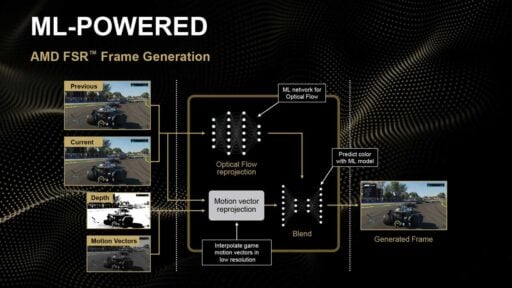
| FSR Frame Gen (ML) | An AI-driven evolution of frame interpolation. It uses optical flow and motion vectors to generate entirely new intermediate frames, making gameplay look smoother. | DLSS Frame Generation |
| FSR Ray Regeneration | An AI “denoiser.” It cleans up grainy lighting effects (reflections and shadows) in ray-traced games in real-time, resulting in sharper lighting. | DLSS Ray Reconstruction |
| FSR Radiance Caching | A technique (currently in SDK) that predicts how light will bounce in a scene to speed up heavy path-tracing workloads. | Neural Radiance Cache |


The Catch
This update has sparked conversation because it ends AMD’s era of universal compatibility for its flagship features. Because Redstone relies on heavy Machine Learning (ML) inference, it requires hardware that older cards simply do not have.
- Exclusive Support: Redstone features are officially locked to AMD RDNA 4 (Radeon RX 9000 series) GPUs, which contain dedicated AI accelerators.
- Legacy Support: Users with older cards (Radeon RX 6000 or 7000 series) cannot use the ML-based Redstone features. They will be limited to the “Analytical” fallback modes, essentially sticking with the standard FSR 3.1 tech.
To add, AMD is not launching FSR4 INT8 as part of Redstone, despite it showing good performance on older RDNA 2 and 3 GPUs.
Launch & Availability
If you are looking to try Redstone as of late 2025, the suite is included in AMD Software: Adrenalin Edition 25.12.1. Call of Duty: Black Ops 7 serves as the official launch title, featuring the new FSR Ray Regeneration technology. Additionally, AMD has stated that over 200 games are expected to receive support for the broader Redstone suite, specifically Upscaling and Frame Gen via patches by early 2026.