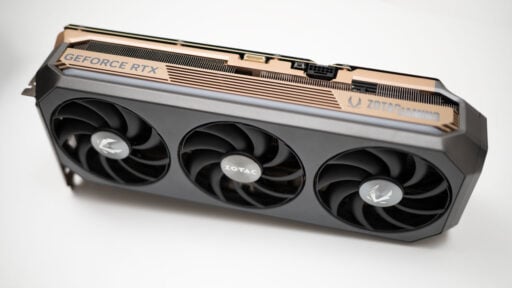
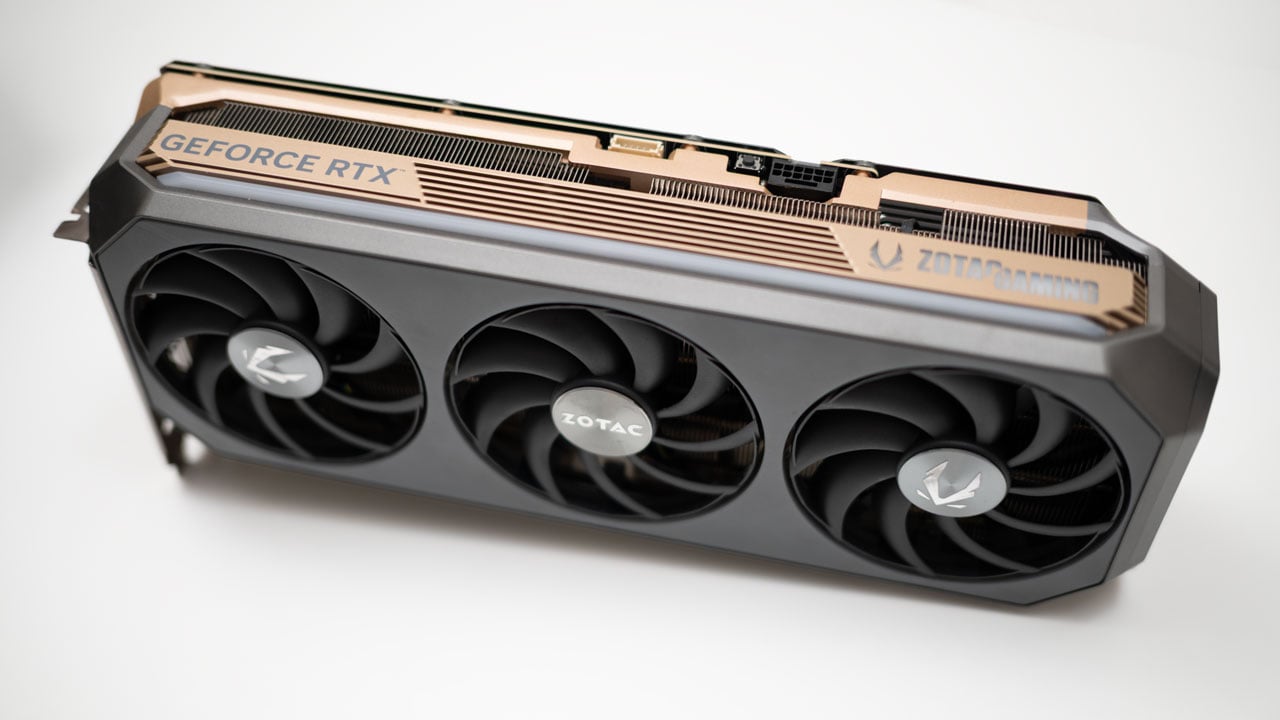
Up for review is the NVIDIA GeForce RTX 5070 Ti, specifically the AMP Extreme INFINITY model from ZOTAC. This high-end non-reference design graphics card packs a Blackwell 2.0 GPU at its core and boasts 16 GB of GDDR7 VRAM.
Disclosure: ZOTAC sent the RTX 5070 Ti AMP Extreme INFINITY for the purpose of this review. The brand did not ask me to say anything particular about it.
Technical Specifications
The GeForce RTX 5070 Ti is an enthusiasts-level graphics card, featuring the Blackwell 2.0 architecture and the GB203 GPU. It packs 16 GB of GDDR7 memory and draws power through a single 16-pin connector. On that note, TDP is rated at 300 W, with a suggested 700 W power supply. This particular ZOTAC model requires at least a 750 W power supply.
| GPU | |
|---|---|
| Cores | 8960 |
| Core Clock | 2512 MHz |
| Architecture | Blackwell 2.0 (GB203) |
| Manufacturing Process | 4 nm |
| TDP | 300 W |
| Memory | |
| Memory Clock | 28 Gbps |
| Memory Bus Width | 256-bit |
| Memory Capacity | 16 GB |
| Memory Type | GDDR7 |
| Bandwidth | 896 GB/s |
| Connectivity | |
| Display | 3x DisplayPort 2.1b, HDMI 2.1b |
| Power | 16-pin |
| Dimensions | |
| Length | 332.1 mm |
| Width | 137.5 mm |
| Height | 69.6 mm |
| Weight | N/A |
Packaging and Accessories
The ZOTAC RTX 5070 Ti AMP Extreme INFINITY comes in a large two part box.

Scope of delivery are as follows:
- ZOTAC RTX 5070 Ti AMP Extreme INFINITY graphics card
- Adjustable graphics card support
- SPECTRA LINK cable
- 3x 8-pin to 16-pin power cable
- Documentation
Design, Layout and Build Quality
The ZOTAC RTX 5070 Ti AMP Extreme INFINITY is a chunky triple-slot graphics card, with two slots dedicated to the PCB and heatsink, plus an extra slot for the 0dB-capable BLADE LINK fans. Its heft also spreads lengthwise at 332.1 mm (~13 inches) so you’d better check if your case fully supports it.

The RTX 5070 Ti AMP Extreme INFINITY features a 2/3-size PCB paired with a cooling setup that blows air into a standard motherboard’s memory slot area. The backplate is significantly thicker compared to most cards, and it might pose clearance issues with small motherboards equipped with I/O plate covers. This graphics card is best paired with larger motherboards featuring an M.2 slot in place of the first PCIe slot.

The RTX 5070 Ti AMP Extreme INFINITY uses a single 16-pin connector (12VHPWR) capable of delivering up to 600 W, far exceeding the card’s 300 W TDP. This provides plenty of headroom for serious overclocking. It also features additional lighting options through the SPECTRA LINK connector and a button to toggle between standard and quiet mode.

Connectivity options include three DisplayPort 2.1b ports and a single HDMI 2.1b port. Ventillation holes are also present at this area, however, the heatsink array suggests it dumps air inside of the case rather than expelling it at the back.

Software
The RTX 5070 Ti AMP Extreme INFINITY works seamlessly with ZOTAC FIRESTORM. While this software is optional, it’s highly recommended to get the most out of your graphics card. FIRESTORM lets you monitor your card’s status, tweak fan speeds and performance, and customize ARGB lighting effects.

3D Rendering
Blender 4.0 measures rendering speed in samples per minute, so higher is better. Monster is the lightest scene per sample here and scores highest, while Classroom is the heaviest and scores lowest. Even there, the RTX 5070 Ti stays close to 2,000 SPM.
AI Image Generation
Procyon’s Stable Diffusion test measures how long the RTX 5070 Ti takes to generate images, so lower is better. The light and standard 1.5 workloads finish in seconds, which is what I would expect from a Blackwell 2.0 silicon. Stable Diffusion XL is much heavier and takes a few minutes.
API Test
3DMark covers four DirectX workloads, and scores drop as the tests get heavier. Fire Strike (DX11) is the lightest and scores highest. Port Royal has ray tracing, and Speed Way is the most demanding test, so they scored the lowest. Still, these are appropriate scores from the RTX 5070 Ti.
Feature Test
Turning on Sampler Feedback gives a small gain of about 10%. DLSS makes the bigger difference, taking the frame rate from around 30 FPS to over 150 FPS, roughly five times higher compared to native.
Counter-Strike 2
The RTX 5070 Ti averages above 400 FPS at 1080p and 1440p, and still reaches about 265 FPS at 2160p. The 1% and 0.2% lows sit well below the averages, which is typical for a Source 2 game.
Cyberpunk 2077
Cyberpunk 2077 is one of the heavier games in the set. It runs near 190 FPS at 1080p and 157 FPS at 1440p. At 2160p it averages 78 FPS, with lows staying above 60 FPS. Enabling DLSS on demanding games at 4K is recommended.
Assetto Corsa
Average frame rate from Assetto Corsa are very high at every resolution tested. The 1440p lows dip lower than the 2160p lows, which suggests the stutter at that resolution is not caused by the GPU.
Forza Horizon 5
At Forza Horizon 5, performance barely changes between 1080p and 1440p, so the game is not fully GPU-bound at the lower resolutions. Even at 2160p the average is well above 180 FPS, with steady lows.
Shadow of the Tomb Raider
Frame pacing is consistent here. The lows stay close to the averages at all three resolutions, and 2160p still averages over 140 FPS.
Horizon Zero Dawn Remastered
This is the most demanding title in the set after Cyberpunk 2077. The RTX 5070 Ti still holds an average of about 102 FPS at 2160p, with the lows staying above 68 FPS.
Total War: Warhammer III
Warhammer III frame rate falls steadily as resolution goes up, from 272 FPS at 1080p to about 102 FPS at 2160p. The lows stay close to the averages throughout, so gameplay remains smooth.
Company of Heroes 3
At Company of Heroes 3, the averages frame rates are high, but the lows are far below them at 1080p, so that result is partly limited by the CPU. At 2160p the game averages 170 FPS.
Temperature
Under load, the RTX 5070 Ti’s core peaks at around 69 °C. The hot spot runs about 13 °C higher at 81 °C, and the memory stays cooler at 58 °C.
Power
The RTX 5070 Ti draws about 30 W at idle and close to 300 W under OCCT load. Nearly all of that comes through the 12VHPWR connector, while the PCIe slot supplies very little.
Noise
Noise was measured with a sound level meter at fixed PWM fan speeds on the RTX 5070 Ti. The fans stop at idle, so the card is nearly silent under light use. Under load, they settle at around 42 dBA, which is essentially at 50% PWM. At full speed, the card reaches 60 dBA which is very load.
| Sound Level Meter | Noise | ||
|---|---|---|
| PWM (%) | Noise (dBA) | Speed (RPM) |
| Idle | ≤ 32 | 0 |
| 30 | 35.2 | 1291 |
| 50 | 41.8 | 1716 |
| 75 | 51.3 | 2357 |
| 100 | 60.1 | 2981 |
| Load | 41.9 | 1736 |
Final Thoughts
The ZOTAC RTX 5070 Ti AMP Extreme INFINITY does what a 5070 Ti should. It handles 1440p at high refresh rates, along with a playable 4K resolution in every game we tested. Most of the other titles stayed above 100 FPS at 4K, while Cyberpunk and Horizon Zero Dawn Remastered may require DLSS to be able to run over 100 FPS.
The massive cooler keeps the 300 W card in check. The core peaked at around 69 °C and the hot spot at 81 °C at around 42 dBA under load, which is audible but not intrusive. At full speed though, the card reaches 60 dBA which is something I wouldn’t consider running the fans at.
The build is the main thing to plan around. The card is 332.1 mm long, takes up three slots, and has a thick backplate that may pose an issue with compact motherboards featuring integrated I/O covers. It also exhausts heat into the case rather than the back, so check your case first if it can swiftly ventilate the hot air out.
Now price is the other factor to check here. NVIDIA’s launch MSRP was $749, but price-watch snapshots listed the RTX 5070 Ti at about $1,029.99. A local listing for this model shows ₱59,895, down from ₱69,000 so be extra vigilant when shopping as GPU prices jumps up and down in a weekly basis.
The factory overclock on the AMP Extreme INFINITY is modest, so the higher price compared to a standard 5070 Ti is many due to the upgraded cooler, fan design, and lighting rather than increased performance. It makes sense if you want a quiet, well-built card, and your case can fit it in. Otherwise, a cheaper 5070 Ti should perform much the same.
ZOTAC RTX 5070 Ti AMP Extreme INFINITY $1,029

Product Name: RTX 5070 Ti AMP Extreme INFINITY
Product Description: The ZOTAC RTX 5070 Ti AMP Extreme INFINITY is a high-end graphics card built on the Blackwell GB203 GPU with 8960 CUDA cores and 16 GB of GDDR7 on a 256-bit bus.
Brand: ZOTAC
Summary
The ZOTAC RTX 5070 Ti AMP Extreme INFINITY delivers strong 1440p and playable 4K performance with a quiet, cool 300 W design.
Pros
- Strong 1440p performance and playable 4K in every game tested
- Fans stop at idle, and load noise is around 42 dBA
- Core temperature stays below 70 °C under load
- Heavy build with a thick backplate and a support bracket in the box
- Triple DisplayPort 2.1b outputs
Cons
- Priced well above the $749 MSRP
- 332.1 mm long and takes up three slots
- Thick backplate can clash with motherboard I/O covers
- Factory overclock is small, so you pay mainly for the cooler and design