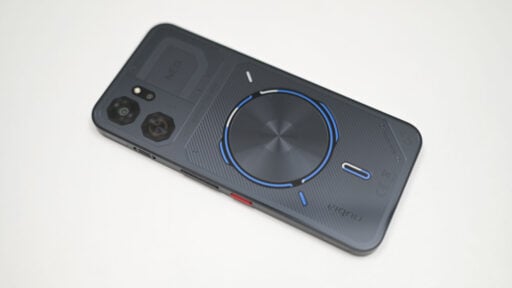
nubia has built its Neo line around gaming smartphones without the flagship price tag. The nubia Neo 5 GT Special Edition pushes that idea further with a feature you don’t normally see outside phones twice its price. For starters, it comes with a built-in cooling fan on top of a liquid cooling solution, 144 Hz OLED display, a 6210 mAh dual-cell battery with 80 W charging, and dedicated shoulder triggers.
The Neo 5 GT appears to be nubia’s attempt at a proper budget gaming flagship. On that note, we spent time with the phone to see how much of that translates outside the spec sheet.
Disclosure: Nubia sent the Neo 5 GT Special Edition for review. All thoughts and opinions are entirely my own.
Technical Specifications
The Neo 5 GT Special Edition has a 6.8-inch AMOLED display with a 144 Hz refresh rate. Cooling comes from a built-in active fan, liquid channels, and a duct design dissipating heat from the CPU and battery. The rear camera is a 50 MP main sensor, with a 16 MP front camera for selfies and video calls.
| Processor | |
|---|---|
| CPU | Mediatek MT6878 |
| Chipset | Mediatek Dimensity 7400 |
| Memory | |
| Capacity | 12 GB LPDDR5 |
| Graphics | |
| GPU | ARM Mali-G615 MC2 |
| Display | |
| Size | 6.8 inches |
| Panel | OLED |
| Resolution | 1224 x 2720 |
| Refresh Rate | 144 Hz |
| Brightness | 4500 cd/m2 |
| Response Time | N/A |
| Camera | |
| Front | 16 MP FF |
| Rear | 50 MP AF + 2 MP DS |
| Storage | |
| Slot | 2x Nano-SIM |
| Capacity | 256 GB |
| Connectivity | |
| Cellular | GSM, HSPA, LTE, 5G, VOLTE |
| Wi-Fi | 2.4G, 5G, 6G |
| Bluetooth | Bluetooth 6.0 |
| USB | USB Type-C 2.0 |
| Audio | |
| Speaker | Stereo |
| Jack | N/A |
| Power | |
| Battery | 6210 mAh |
| Charging | 80 W |
| Dimensions | |
| Length | 163.6 mm |
| Width | 75.8 mm |
| Height | 8.4 mm |
| Weight | 200 grams |
Power comes from a 6,210 mAh dual-cell battery with 80 W wired fast charging. Gaming controls include Neo Trigger shoulder buttons with a 550 Hz sampling rate which is new to me. The phone carries an IP64 rating for dust and splash resistance, and runs MyOS 16 which is based on Android 16.
Packaging and Accessories
The Neo 5 GT arrives in the standard nubia smartphone packaging, complete with a generous selection of accessories inside.
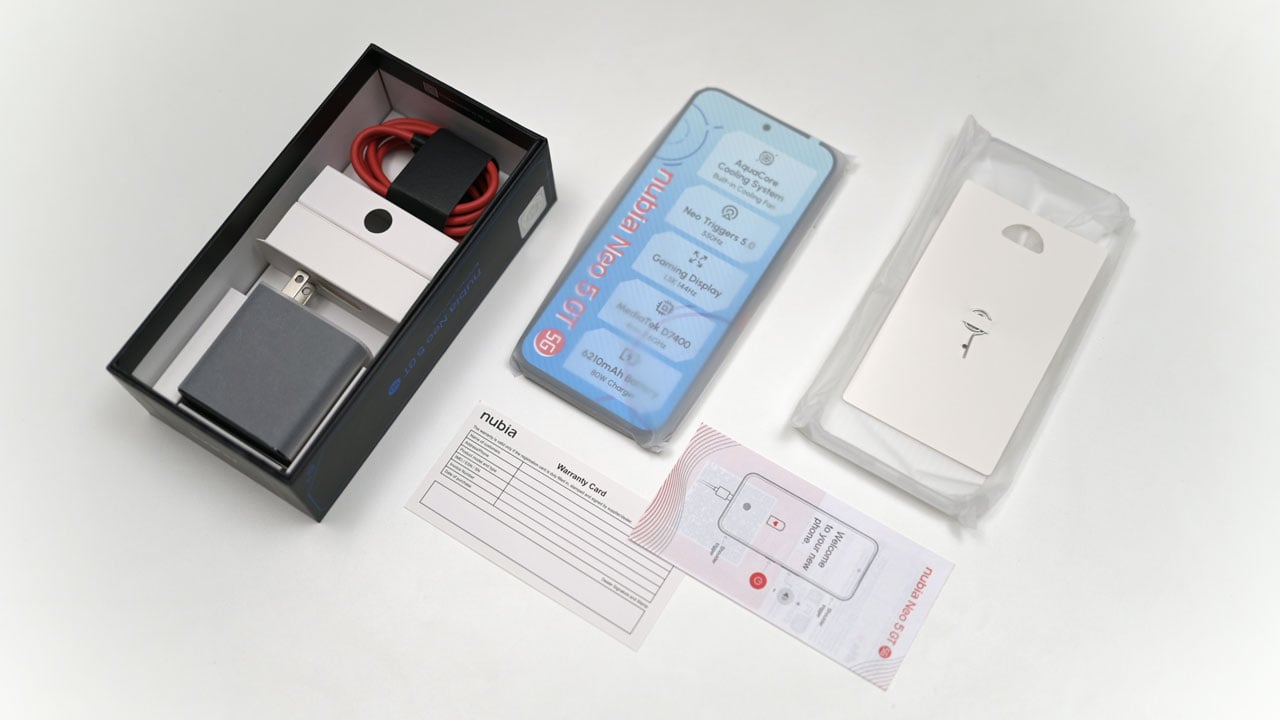
Scope of delivery are as follows:
- nubia Neo 5 GT Special Edition smartphone
- Clear case
- Charger
- USB Type-C to Type-A cable
- SIM card remover
- Documentation(s)
Design, Build and Connectivity
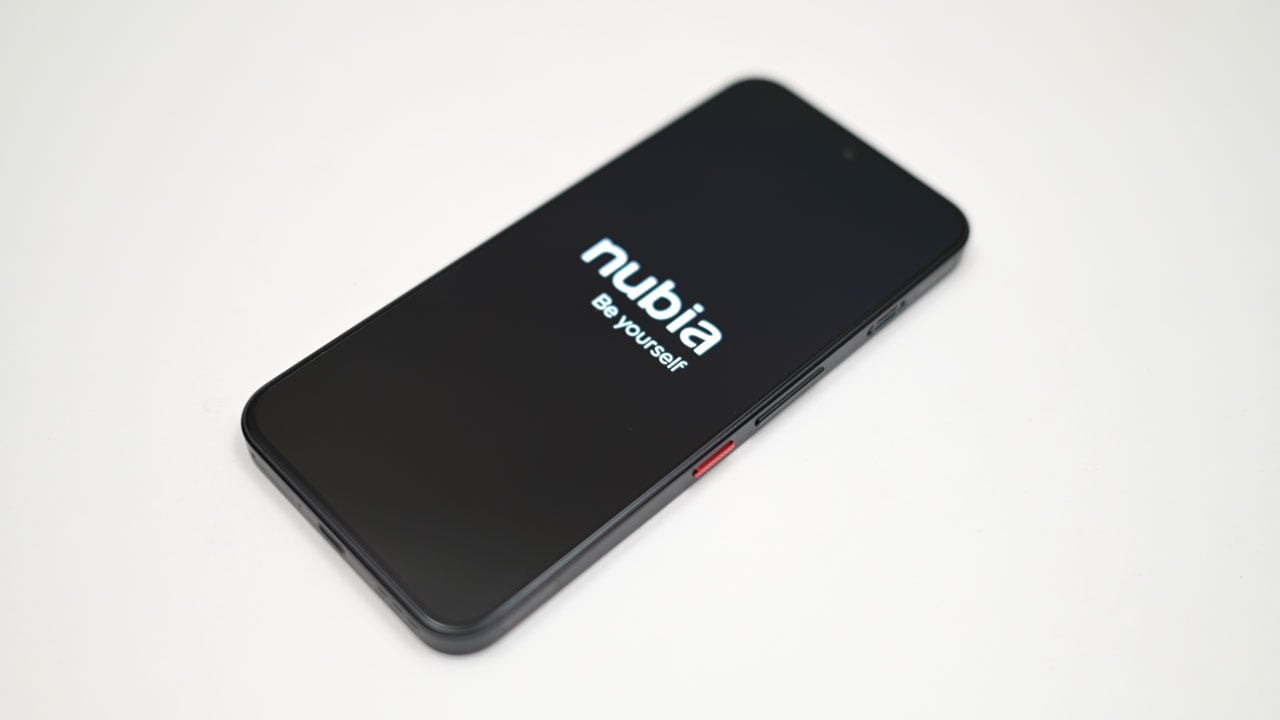
The nubia Neo 5 GT in its Special Edition variant is available in three colors: phantom black, stellar silver, and electro gold. The phone features a massive 6.8-inch IPS display with a 144 Hz refresh rate, comes with a pre-installed screen protector, and includes the iconic multipurpose button that has become a signature for nubia devices.
The Neo 5 GT sports a rear panel with a clear gamer aesthetic yet maintains a sleek, refined look. It’s been ages since I’ve come across a smartphone with a flush camera, making it a refreshing change considering the amount of hardware inside. This includes a fan paired with a liquid cooling system, a rare combo exclusive to the 5G Special Edition. Seeing it in action is oddly therapeutic and should help tremendously in dissipating heat from both the CPU and battery.
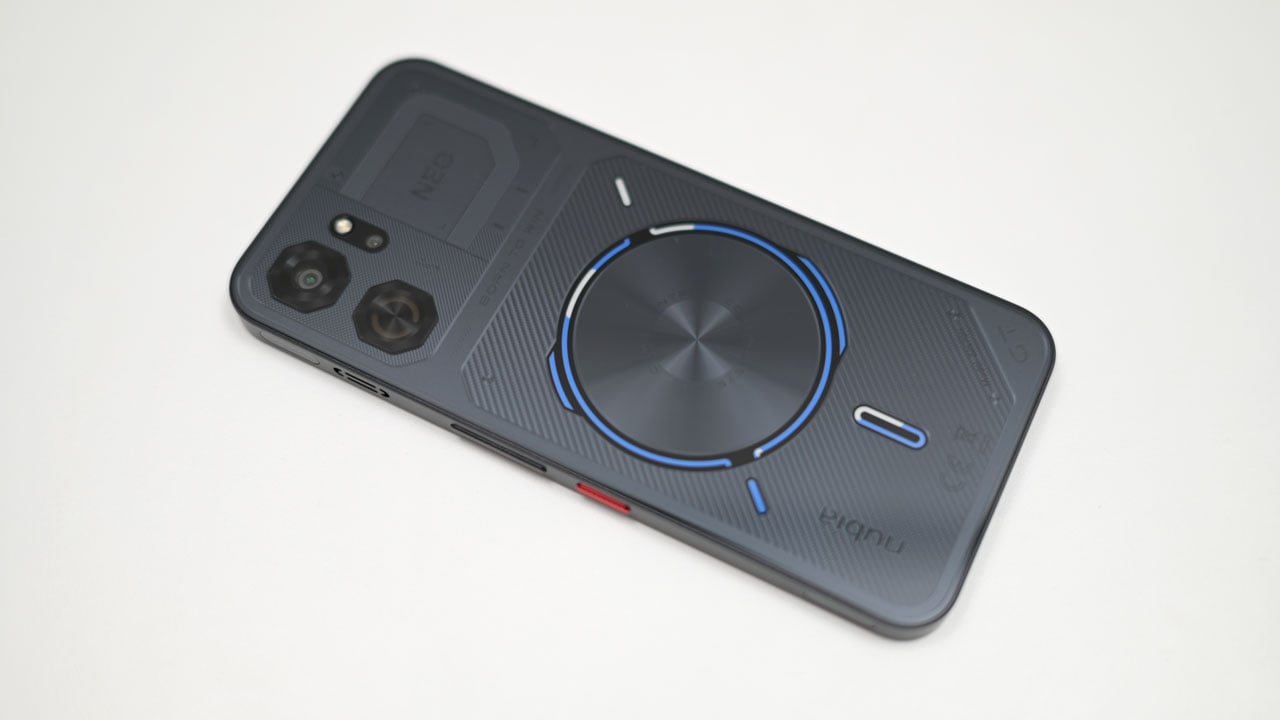
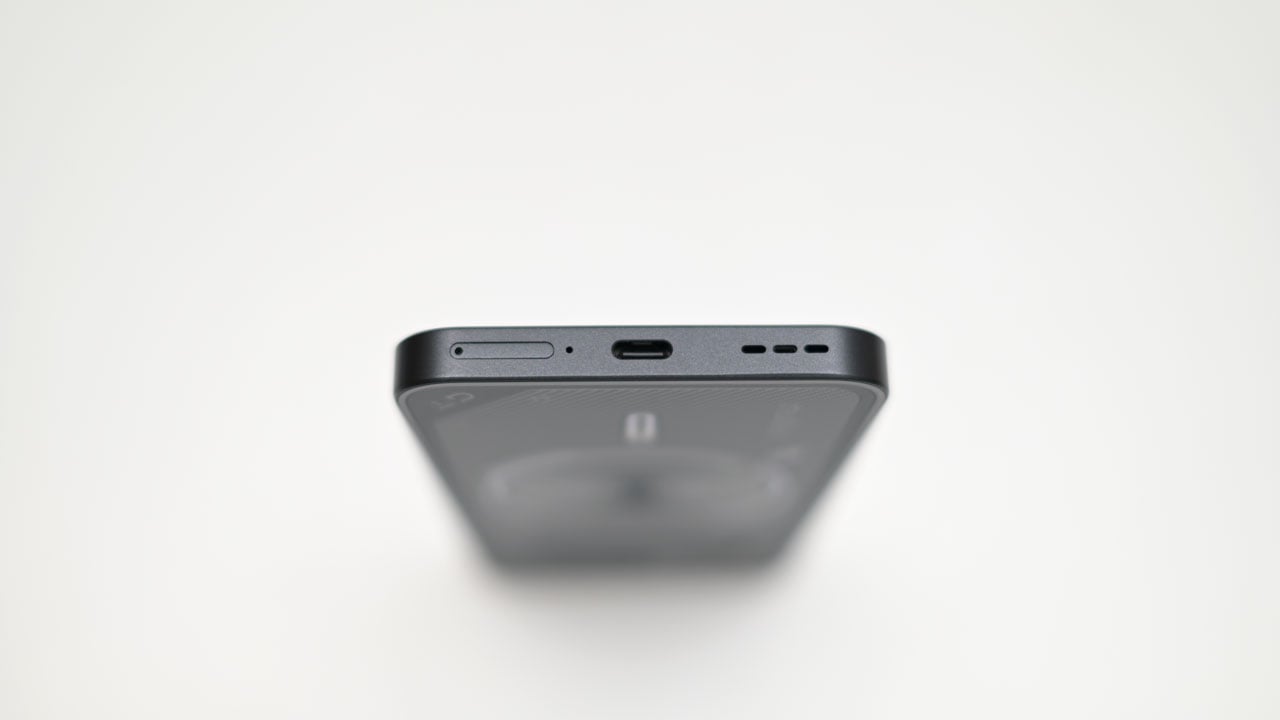
The Neo 5 GT packs five physical buttons, including shoulder triggers for gaming. For connectivity, it offers a back-to-back dual SIM tray, a USB Type-C port for data and charging, a down-firing stereo speaker, and dual microphones. There’s no 3.5 mm headphone jack, which is a bit disappointing, but you can always use the Type-C port with an adapter if the need arises.
Ergonomics
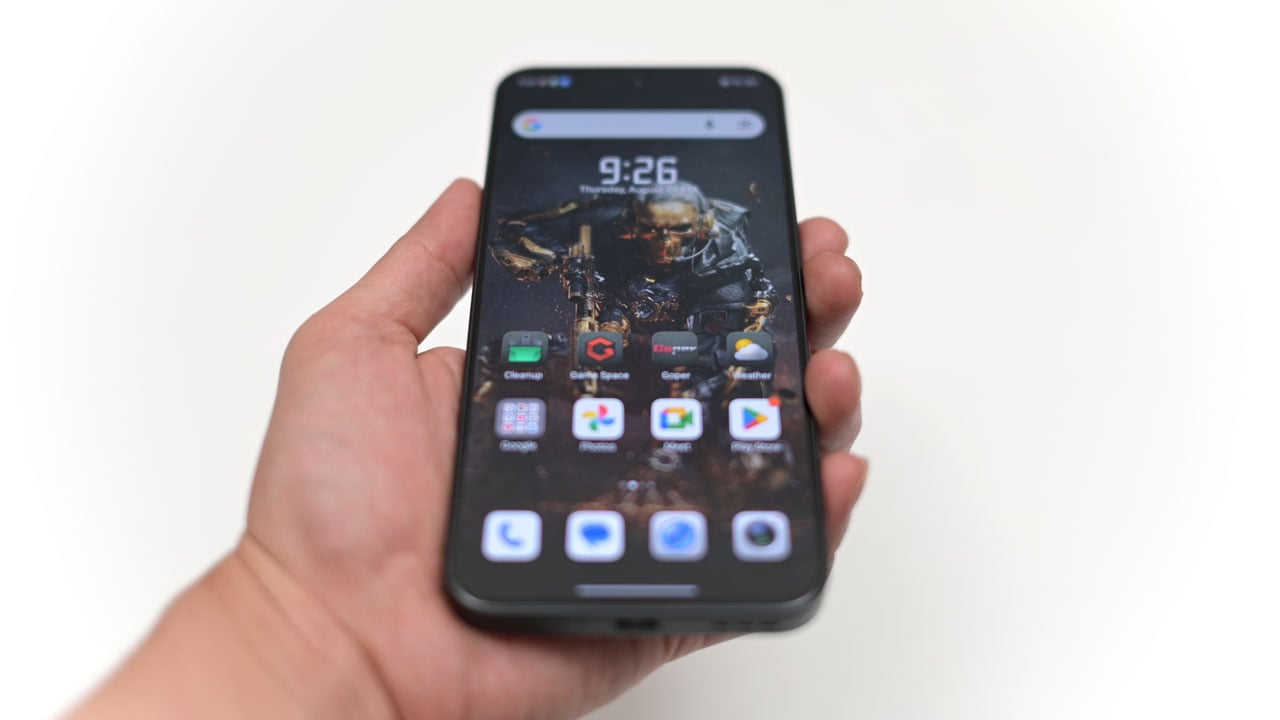
The Neo 5 GT weighs about 206 grams, putting it right in the middle range for smartphones of its size. Considering all the stuff it’s packing, that’s an accomplishment on its own.

With a 1224 x 2720 resolution on a 6.8-inch OLED screen, the display is a perfect fit. Pixel peeping won’t get you anywhere, as the Neo 5 GT packs 438.63 PPI. That’s more than an Apple Retina display and only 22 PPI shy of the iPhone 17.
Interface
nubia has stuck closely to its tried-and-true formula with the MyOS 16, so anyone who’s used the OS before will notice the interface remains largely the same as in previous versions.

There are, of course, minor differences and additions, mostly related to the build and tied to the features of the Neo 5 GT. These include the default theme and other gamer-focused applications, such as Demi, which is a customizable AI companion.

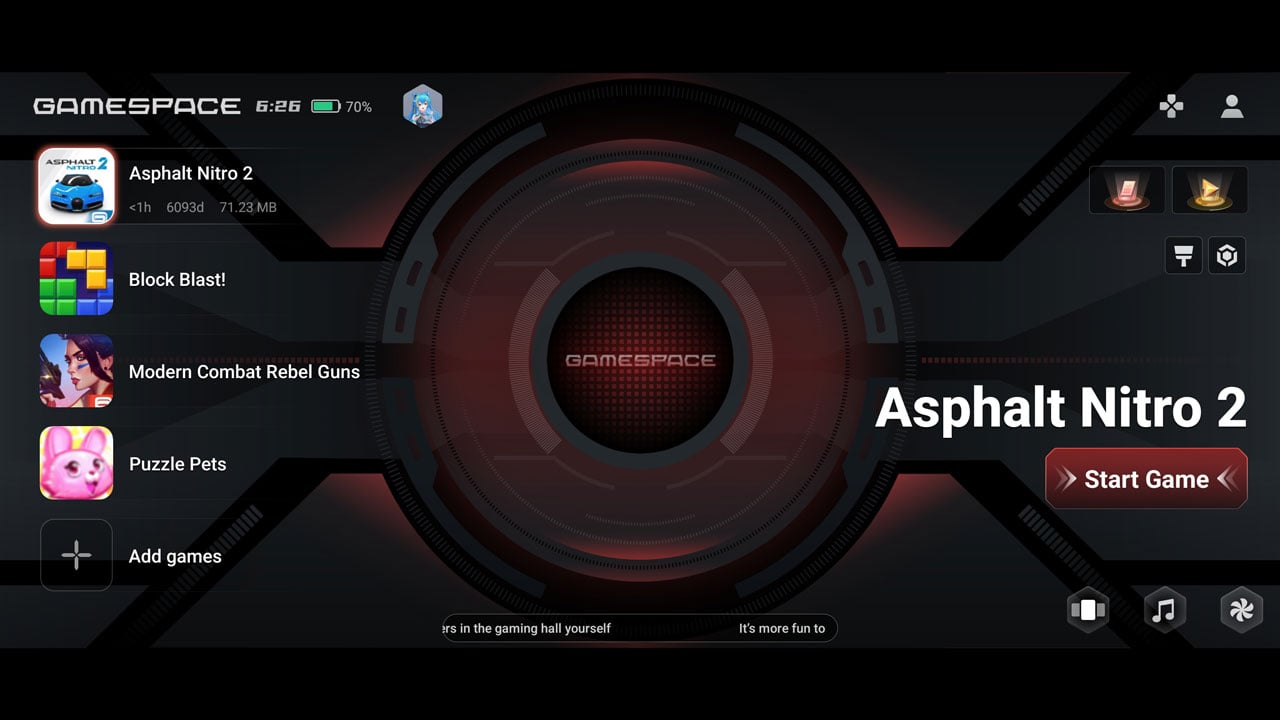
Game Space is a launcher that provides one-tap controls for performance settings, automatic optimization, and useful tools to reduce distractions while gaming. It also features Demi as a coach, but I haven’t been able to get her working properly here.
AI Inference
Normal and Power-saver mode are essentially identical at the NNAPI backend based AI benchmarks.
Content Creation
Interestingly, switching from Normal to to Power-saver mode still didn’t show any performance costs in these content creation subtests.
Productivity
Single-core results are mostly flat between the two profiles, with a couple of small dips.
Compression
Interestingly, Power-saver mode came out marginally ahead in both tests in File Compression, and in Asset Compression. The gaps are small enough (roughly 2-3% and under 1%, respectively) that they likely fall within normal run-to-run variance rather than indicating any real performance advantage for the power-saving profile.
Gaming
These 3DMark results tell a similar story to the CPU tests: performance is essentially unchanged between Normal and Power-saver profiles. The consistent pattern across both this GPU-focused suite and the earlier results suggests that enabling Power-saver mode doesn’t cost any meaningful performance on this system.
The Steel Nomad Light result looks alarming out of context, but that test is punishing even on flagship silicon since it uses heavy compute and ray tracing workloads. That said, it isn’t unusual, it just confirms the GPU isn’t built for ray-traced or console-tier loads. Wild Life at ~22 FPS is a solid mid-range result, consistent with the Dimensity 7400 platform. Sling Shot GT1 at ~40 FPS is where this chipset is comfortably capable, which lines up with how most current mobile games are still built.
Storage
The 256 GB nubia Neo 5 GT Special Edition hit sequential read speeds of 1010 MB/s and write speeds of 626.41 MB/s in the Cross Platform Disk Test under normal operation. In Power-saver mode, the read speed is close to Normal, while the write speed dipped slightly to 596.07 MB/s. Still, those are impressive numbers especially when compared to eMMC equipped phones.
Network
The nubia Neo 5 GT fully supports Wi-Fi 6G, and I’m getting solid 5G speeds here with good latency to match. On a proper 5G network, the speed isn’t too far off from our 6G results, except for the upload speed. The 2.4G performance is about what I’d expect in a worst-case scenario, along with VoLTE connectivity – my location considered. Actually not bad overall.
Display
The Neo 5 GT sports a large 6.8-inch AMOLED display with a smooth 144 Hz refresh rate. While marketing claims list a 4500-nit peak, real-world testing hits 641.7 cd/m2. The manufacturer’s figure is likely for HDR, but that also cannot be true since I have tested HDR to be at 660 cd/m2 APL in a 4% window.
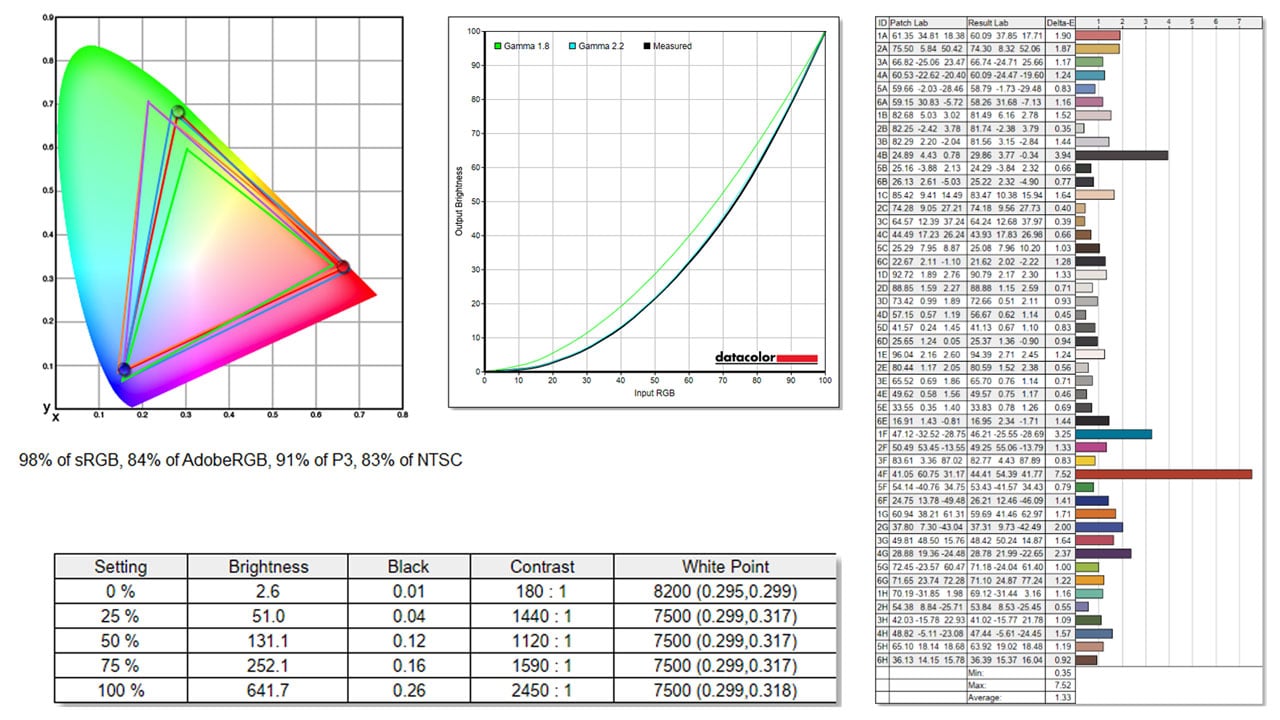
Sticking on our benchmarks, the Neo 5 GT delivers great tone control, along with outstanding contrast ratio, color coverage, and color accuracy for its class. I’m genuinely impressed.
| SpyderPRO | Display | |
|---|---|
| Parameter | Measured |
| Color Gamut | 98% sRGB |
| Brightness | 641.7 cd/m2 |
| Contrast | 2450:1 |
| Gamma | 2.2 |
| Temperature | 7500 K |
| Color Accuracy | 1.33 ΔE |
Audio
Tests reveal that the Neo 5 GT’s audio output is surprisingly decent for its class, with a signal-to-noise ratio of 67.5 dB, THD+Noise at 0.043%, and Noise+Distortion at -93.8 dBFS via a USB Type-C adapter. The external audio holds up well too, given it’s powered by just a down-firing stereo speaker.
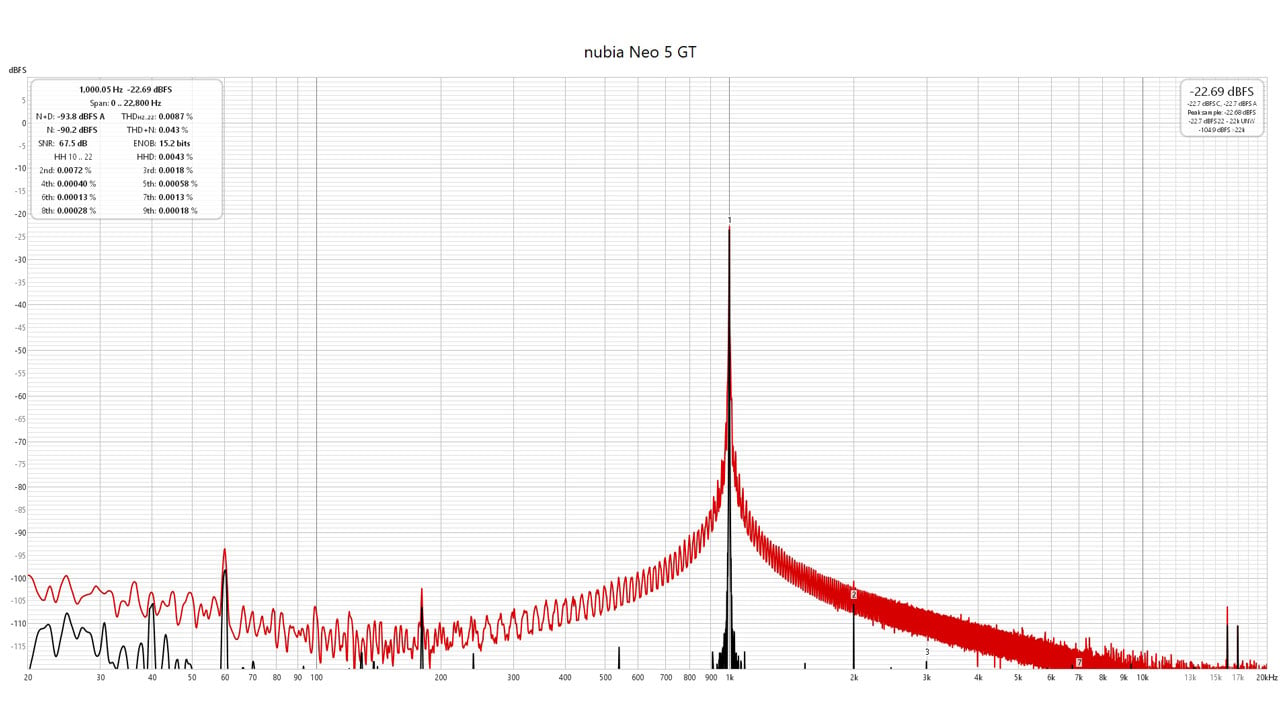
Note that the 60 Hz anomaly is a ground loop artifact caused by running the test notebook on mains power; please disregard it. The remaining measurements reflect the device’s true audio performance.
| REW | Audio | |
|---|---|
| Parameters | Measured |
| THD | 0.0087% |
| THD+N | 0.043% |
| Noise | -90.2 dB |
| N+D | -93.8 dB |
| SNR | 67.5 dB |
| ENOB | 15.2 bits |
Camera
Considering its price and purpose, the nubia Neo 5 GT’s 50 MP main camera delivers impressive results. It’s a big step up from the last nubia device I tested, with the Neo 5 GT providing good exposure, natural colors, and excellent image quality for its category.

Temperature
We ran the Neo 5 GT through FLIR thermal imaging alongside its own internal sensor logs, both at idle and under sustained load, across Normal and Power-saver modes.

At idle, both the front and back panels sit around 29 °C, with barely any spread between hotspots. Under load, the front panel climbs to a 35.0 °C average with a 38.8 °C peak near the lower edge, while the back hits 33.7 °C average with a 37.5 °C peak around the camera module. These are reasonable numbers for a phone running active cooling under sustained load.
The internal sensor data adds a twist. Normal mode goes from 29 °C idle to 33 °C under load, a 4 °C climb. Power-saver goes from 32 °C to 38 °C, a 6 °C climb that ends up hotter than Normal mode despite doing less work.
This seems rather counter-intuitive, but the reason is cooling. Normal mode keeps the fan and liquid cooling loop running, so heat gets carried away as it builds. Power-saver mode cuts the fan to save battery, leaving the SoC to cool passively.
Power
At idle, Normal and Power-saver modes pull nearly the same wattage, so there’s little difference in how the system behaves at rest. Under load, the gap widens with Normal mode drawing 7.69 W while Power-saver drops to 5.38 W, a cut of about 30%.
Battery Life
We ran PCMark’s Work 3.1 battery life test twice, once in Normal mode and once in Power-saver mode, to compare how each profile drains the battery over the course of the benchmark.
Both runs start at 99% and track closely for the first several passes, but the two lines start pulling apart quickly. By Pass 10, Normal mode is already down to 78% while Power-saver is still sitting at 90%. That gap holds through the middle of the test and by Pass 40 it’s 40% against 60%. Power-saver consistently runs 15-20 percentage points ahead of Normal at every checkpoint through this stretch.
Final Thoughts
The nubia Neo 5 GT Special Edition delivers on the core promise of a budget gaming phone with genuinely uncommon hardware. The fan and liquid cooling combo visibly does its job, keeping the Normal profile’s thermal climb to just 4 °C under sustained load while Power-saver, running passively with the fan off (excluding some benchmark runs), actually ends up hotter despite drawing less power. That’s the most interesting finding from testing, and it’s a good reminder that power saving doesn’t always mean cooler.
That said, across CPU, GPU, AI, and storage benchmarks, the performance gap between Normal and Power-saver is marginal at best, often within run-to-run variance. Given how close the two profiles land in actual output, and the meaningful battery life gain Power-saver brings, it’s reasonable to just leave the phone in Power-saver most of the time and only switch to Normal for longer, more demanding sessions where the extra cooling headroom matters.
Elsewhere, the phone punches above its ₱26,599 price point. Display accuracy and contrast are excellent for the class, storage speeds are desktop-grade, network performance held up well across Wi-Fi 6G, 5G, and even VoLTE (location considered), and the 50 MP main camera produces clean, natural shots. Battery life in Power-saver mode is also a clear standout, stretching runtime by roughly two hours over Normal in our PCMark test.
The rough edges are mostly software and design compromises rather than performance ones. Demi, the AI coach built into Game Space, didn’t work properly during testing, and the missing 3.5 mm jack means USB-C is your only wired audio option. The gap between the marketed 4500-nit HDR brightness figure and the measured 641.7 cd/m2 is also worth flagging for gamers chasing a good HDR output.
Taken as a whole, the Neo 5 GT Special Edition is a great pick for anyone who wants dedicated gaming hardware, active cooling, and a big battery without paying flagship prices, as long as they’re willing to work around a few forgivable quirks.
nubia Neo 5 GT Special Edition ₱26,599

Product Name: Neo 5 GT Special Edition
Product Description: The Neo 5 GT Special Edition is a midrange gaming smartphone with active fan and liquid cooling, a 144 Hz OLED display, 6210 mAh battery with 80 W charging, and dedicated shoulder triggers for serious mobile gaming.
Brand: nubia
Summary
The nubia Neo 5 GT Special Edition packs active cooling, a capable display, and strong network and storage performance into a midrange gaming smartphone, with the main trade-offs being a half-baked AI coach feature, HDR, and the death of analog audio output.
Pros
- Active fan plus liquid cooling keeps thermals in check
- Display accuracy, contrast, and color coverage for the price
- Fast, consistent storage read and write speeds
- Reliable 5G, Wi-Fi 6G, and VoLTE performance
- Good 50 MP camera output for a gaming phone
- Power-saver mode meaningfully extends battery life
- Dedicated shoulder triggers with high sampling rate for gaming
- Flat-design is a breath of fresh air vs camera island infested phones
Cons
- Demi AI coach didn’t function properly in testing
- No 3.5 mm headphone jack
- Real-world HDR peak falls short of the marketed 4500-nit figure



The phone has allways on display?
It doesn’t offer the feature natively, but you could download an app for it to work.