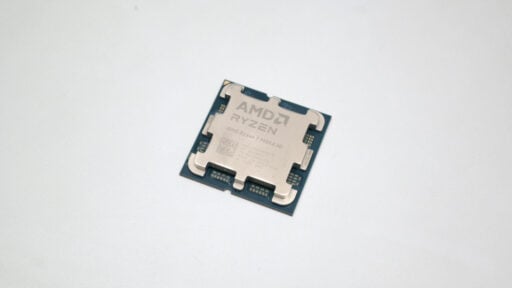
The AMD Ryzen 7 9850X3D is a high-frequency upgrade to the Zen 5 architecture, building on the thermal and cache advancements of the Ryzen 7 9800X3D. It keeps the same 8-core, 16-thread setup and the hefty 96 MB of L3 cache that made its predecessor a gamer favorite, but uses better silicon binning to boost the max clock speed to 5.6 GHz. That’s a 400 MHz jump, leaving us to wonder if a 7.7% increase in speed is enough to justify its roughly similar higher price.
Disclosure: AMD provided the Ryzen 7 9850X3D desktop processor for this review, without requesting any specific comments or opinions.
Table of Contents:
Technical Specifications
The Ryzen 7 9850X3D sticks with the second-generation 3D V-Cache design introduced with the 9800X3D. Along with a boost clock increase, it now officially supports up to 256 GB of total memory capacity. That’s pretty much it.
| CPU | |
|---|---|
| Core/Thread | 8-cores/16-threads |
| Base/Boost Clock | 4.7 GHz/5.6 GHz |
| Architecture | Zen 5 (Granite Ridge) |
| Manufacturing Process | TSMC 4 nm FinFET (CPU), 6 nm FinFET (I/O Die) |
| TDP | 120 W |
| Memory | |
| Memory Speed | 5600 MT/s |
| Memory Channels | 2 |
| Memory Capacity | 256 GB |
| Memory Type | DDR5 |
| Graphics | |
| Model | AMD Radeon Graphics |
| Core | 2 |
| Frequency | 2200 MHz |
| Connectivity | |
| PCI Express | PCIe 5.0 |
| PCI Express Lanes | 28 (24 usable) |
| Dimensions | |
| Length | 40 mm |
| Width | 30 mm |
| Height | 8 mm |
| Weight | 104 grams (package) |
Packaging and Accessories
The AMD Ryzen 7 9850X3D comes in a slim box, much like the 9800X3D, and doesn’t include a cooler.
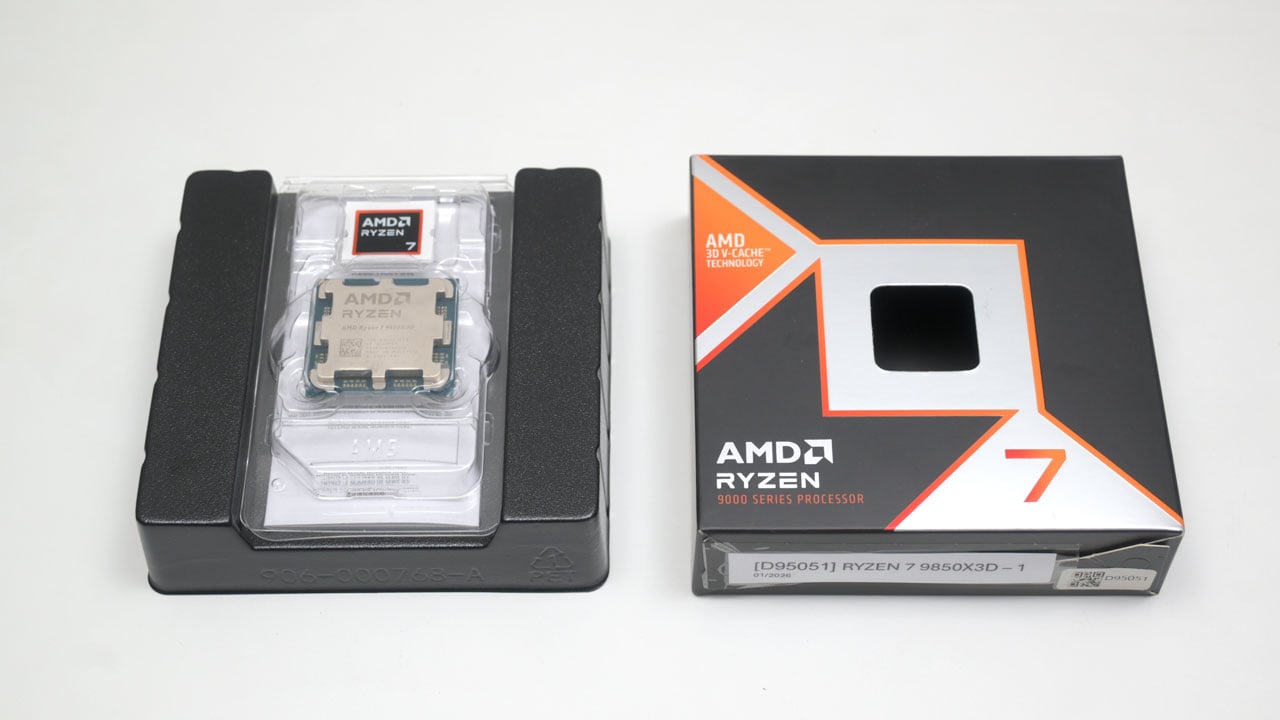
Scope of delivery are as follows:
- AMD Ryzen 7 9850X3D desktop processor
- AMD Ryzen badge
- Documentation(s)
Design, Layout and Connectivity
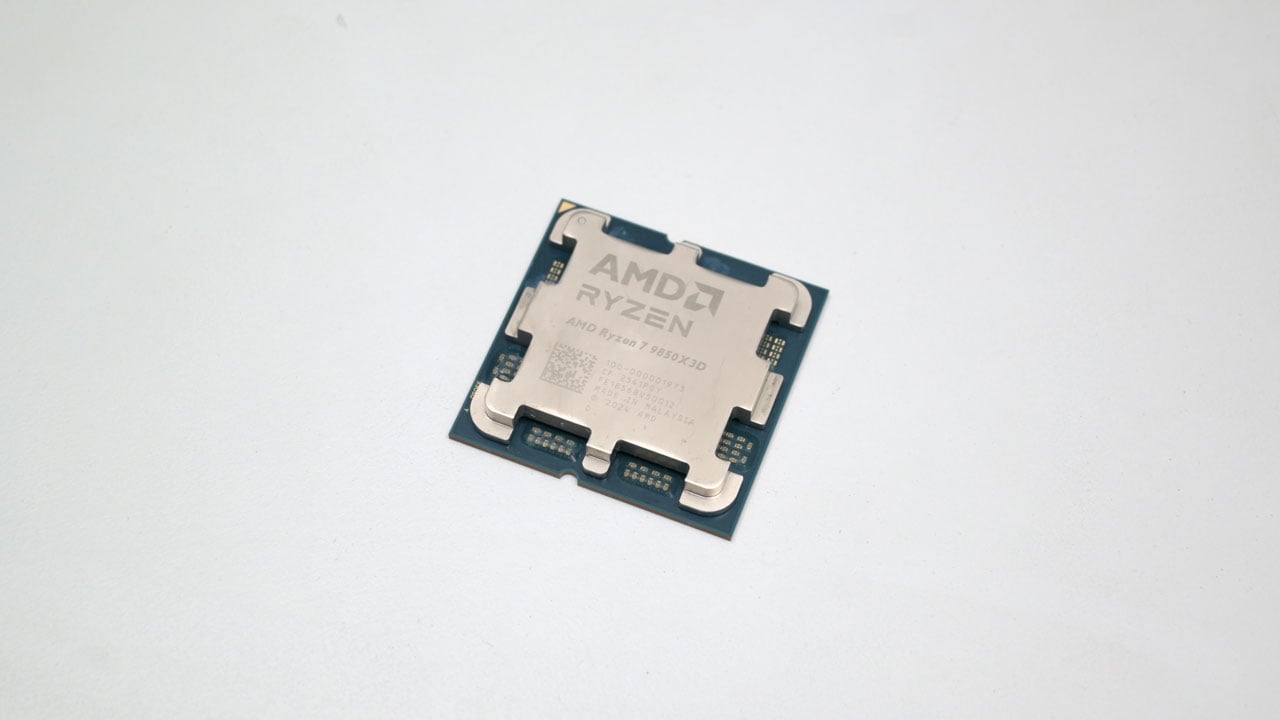
The Ryzen 7 9850X3D runs on the Zen 5 architecture for the AMD AM5 platform, offering what the 9800X3D did but with a higher boost clock. Again, the massive cache is under the CCD, ensuring the cores maintain a more efficient contact with the Integrated Heat Spreader (IHS) for better heat dissipation.
I tested the Ryzen 7 9850X3D with all available Precision Boost Overdrive (PBO) presets – 65 W, 105 W, 170 W, and the system defaults. I’m particularly interested in how these results compare, so refer to our Ryzen 7 9800X3D review for a direct side-by-side if that’s what you’re after. Note that I used the AMD Radeon RX 9070 XT, so benchmarks involving GPU usage (like Premiere Pro and games) aren’t directly comparable.
Throughput
Memory throughput on the Ryzen 9 9850X3D is remarkably consistent across all power limits, with read speeds hovering around 59 GB/s and write speeds near 79-80 GB/s regardless of TDP setting. Copy speeds and latency tell a similar story, with negligible differences between 65 W and Default. This suggests the CPU’s memory subsystem is not power-constrained, and even the most aggressive power savings have virtually no impact on bandwidth or latency.
Encryption
AES encryption performance scales modestly with the presets, climbing from 84,873 MB/s at 65 W to a peak of 87,390 MB/s at Default, roughly 3% difference. SHA3 throughput follows the same trend, jumping noticeably from 65 W to 105 W but plateauing beyond that.
3D Rendering
Blender performance shows the clearest power scaling of any test here. At 65 W, the chip trails significantly — for example, Monster scores just 150.50 SPM versus 172.18 SPM at Default, a gap of nearly 15%. The jump from 65 W to 105 W recovers most of that deficit, with diminishing returns between 105 W, 170 W, and Default. For sustained rendering workloads, 65 W is a meaningful compromise, but 105 W hits a solid efficiency sweet spot.
AI Inference
Results are measured in milliseconds, so lower is better. The 65 W profile shows the most pronounced slowdown, particularly on heavier models. YOLO V3 takes 38.79 ms at 65 W versus 32.68 ms at 105 W, an 18% regression. Lighter models like MobileNet V3 are largely unaffected across all settings. The 105 W and 170 W profiles perform closely.
Content Creation
Adobe application scores are extremely close across all four power profiles, with differences well within the margin of run-to-run variance. Photoshop, Lightroom, and Premiere Pro all fluctuate by only around 1-2%, with no consistent winner across the board. This is good news for creators as the 9850X3D can be run at 65 W without any meaningful sacrifice in day-to-day content creation workflows.
Productivity
Microsoft Office workloads are similarly flat across power settings, with scores shuffling within a narrow band for Word, Excel, PowerPoint, and Outlook. No single power profile dominates consistently, and the variance is small enough to be attributable to margin of error rather than actual performance differences. The 9850X3D handles productivity tasks comfortably at any PBO preset.
Compression
7-Zip compression scales more clearly with power than the office or content creation tests. At 65 W, scores drop noticeably, roughly 5-8 GIPS lower than the other profiles across all dictionary sizes. Performance at 105 W, 170 W, and Default is very close, so the processor doesn’t need to go beyond 105 W to deliver near-peak compression throughput.
Gaming
Gaming performance is essentially flat across all four power profiles, with frame rate differences of just 1-5 FPS across every title tested which is well within typical benchmark variance. Whether running at a frugal 65 W or the full Default profile, Counter-Strike 2, Assetto Corsa, Shadow of the Tomb Raider, and Total War: Warhammer III all deliver identical real-world results. This shows the 9850X3D’s gaming-focused design, with its 3D V-Cache architecture ensuring steady frame rates no matter the power limits.
Temperature
Idle temperatures are predictably similar across all profiles, sitting in the low 50°C range. Load temperatures tell a more dramatic story. 65 W stays impressively cool at just 63.89°C, while 105 W jumps to 89.14°C and 170 W peaks at 94.22°C, with Default close behind at 92.75°C. For those prioritizing thermals and acoustics, the 65 W profile offers a substantial cooling advantage that is very much real.
Power
One of the more interesting findings here is that the processor’s actual power draw doesn’t match its configured TDP profiles. Under load, the 65 W profile draws 87.59 W, the 105 W profile pulls 141 W, and the 170 W profile reaches 153.62 W; all meaningfully above their respective targets. Default sits at 150.56 W, which is nearly identical to the 170 W profile in practice.
This suggests AMD’s power management is running looser than the profile labels imply, and you shouldn’t take the TDP figures at face value when planning your build. That said, the 65 W profile draws the least power by a wide margin and delivers competitive performance across most workloads, making it my choice for efficiency-focused builds despite the mismatch.
Final Thoughts
The Ryzen 9 9850X3D is a processor that largely delivers on its promise, particularly for those who need multi-threaded muscle alongside strong gaming performance. But, it comes with a few caveats worth understanding before purchase.
Across the board, the most striking finding isn’t raw performance, but how little performance changes between power profiles in most workloads. Gaming results are virtually identical whether the chip is capped at 65 W or running at Default, and the same holds true for productivity, content creation, and memory throughput. The 3D V-Cache architecture clearly does a lot of the heavy lifting here, keeping the processor competitive without needing to draw excessive power. Where the extra clock speed genuinely earn its place is in sustained multi-threaded workloads. 3D rendering and compression in particular show meaningful advantages over the 9800X3D.
For pure performance, the 105 W profile hits the best sweet spot, recovering most of the deficit seen at 65 W in compute-heavy tasks while drawing significantly less than 170 W or Default. Gamers, meanwhile, can run the most restrictive profile available and lose nothing measurable in return, just as they could on the 9800X3D.
The choice between the two chips ultimately comes down to use case: if gaming is the primary workload, the 9800X3D remains a very compelling option. But for those who also push multi-threaded workloads regularly, the 9850X3D’s added speed boost justify the step up.
AMD Ryzen 7 9850X3D Desktop Processor $499

Product Name: Ryzen 7 9850X3D
Product Description: The AMD Ryzen 7 9850X3D is a high-performance desktop processor built on the Zen 5 architecture, featuring 8 cores and 16 threads with AMD's 2nd Gen 3D V-Cache technology.
Brand: AMD
Summary
The AMD Ryzen 7 9850X3D sits above the 9800X3D in the stack by making it a bit more versatile option for creators and power users who don’t want to compromise on gaming performance in the process.
Pros
- Consistent gaming performance across all power profiles
- Clear multi-threaded advantage over the 9800X3D in rendering and compression
- Efficiency at 65 W for everyday and lightly threaded workloads
- Memory throughput and latency unaffected by power limits
- 105 W profile offers a balance of performance and power draw
- Runs cool and quiet at 65 W, ideal for constrained builds
Cons
- PBO still don’t reflect actual consumption
- Performance drop at 65 W in sustained, heavily threaded workloads
- No meaningful gaming advantage over the 9800X3D
- Runs hotter at higher power profiles, demanding a more capable cooling solution
- Little to no benefit running beyond 105 W for most workloads