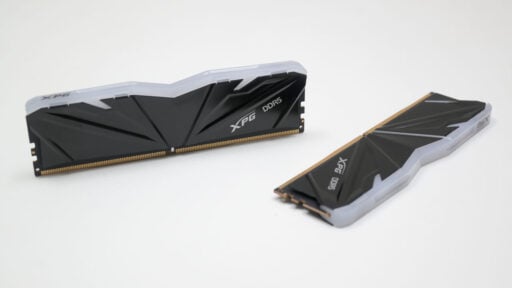
This review covers the XPG ARMAX RGB DDR5-6000 memory from ADATA. It is a 32 GB kit boasting up to 6400 MT/s speeds at CL30, and ARGB lighting on top of a low-profile design.
Disclosure: ADATA sent the XPG ARMAX RGB DDR5-6000 memory kit for this review.
Table of Contents:
Technical Specifications
The XPG ARMAX RGB we have is a DDR5-6000 32 GB kit, made up of two 16 GB DDR5 sticks with a rated speed of 6000 MT/s at CL30. It comes with a PMIC, On-Die ECC, and supports both the latest Intel XMP 3.0 and AMD EXPO.
| Memory | |
|---|---|
| SDRAM | DDR5 |
| Interface | LO-DIMM |
| Capacity | 32 GB (2x 16 GB) |
| Speed | 6000 MT/s |
| Timings | CL30-40-40 |
| Voltage | 1.4 V |
| Dimensions | |
| Length | 133.35 mm |
| Width | 8.5 mm |
| Height | 39.49 mm |
| Weight | 43.16 g |
Packaging and Accessories
The XPG ARMAX RGB DDR5-6000 memory kit is packaged in a clamshell packaging.

Scope of delivery are as follows:
- 2x 16 GB XPG ARMAX RGB DDR5-6000 memory
Design, Layout and Connectivity
XPG built the ARMAX RGB around a low-profile heatsink with a V-shaped slope at its center. ADATA claims fighter jets inspired the aesthetic. It’s abstract enough that it’ll pass for an F1 nose cone if they said so instead.

The ARMAX’s integrated PMIC handles power directly on the module for better stability and efficiency. You also get On-die ECC, which essentially fixes memory errors in real-time. This memory kit has SK Hynix memory chips inside.

The RGB lighting looks amazing right out of the box. That said, I haven’t had a chance to check the ARMAX’s compatibility with motherboard sync technologies.

The XPG ARMAX RGB offers two profiles: the Default, following JEDEC specs at DDR5-4800 (CL 40-39-39-77), and the XMP/EXPO running at DDR5-6000 (CL 30-40-40-76). We’ll be testing both on our AMD setup, which includes a Ryzen 9 7900X CPU, Radeon RX 7800 XT GPU, and an ASUS ROG Strix X670E-I Gaming WiFi motherboard.
Throughput
AIDA64 shows a clear performance dip when the memory kit runs at JEDEC specs (DDR5-4800). In contrast, the XPG ARMAX RGB DDR5-6000 is tuned for top performance using its XMP or EXPO profile in this benchmark. The standout here is its latency, coming in at 65.1 ns.
Encryption
The two memory profiles tested delivered similar results in AIDA64’s AES and SHA3 benchmarks, but the JEDEC DDR5-4800 profile came out slightly ahead in overall speed.
3D Rendering
In Blender, the XPG ARMAX RGB’s XMP/EXPO profile shows mixed performance across all tested scenes. It is slower at both Monster and Classroom, while it is faster at the Junkshop render scene.
AI Inference
In AI inference benchmarks, the XPG ARMAX RGB running at DDR5-6000 turns out to be slower than the JEDEC profile for most of the neural models tested.
Content Creation
The DDR5-6000 profile boosts performance in Photoshop, Lightroom, and Premiere Pro.
Productivity
Most Microsoft Office apps got a boost with the faster profile, but Word was the exception.
Compression
Switching from DDR5-4800 to DDR5-6000 resulted in a slight boost in overall compression speed.
Gaming
Gaming performance, however, is disappointing. I even looked at the 1% low FPS and noticed no significant improvement.
Temperature
The XPG ARMAX RGB’s thermal output noticeably rises when the memory operates at higher speeds, but it’s nothing concerning, especially when using the EXPO profile.
Power
A power draw of around 3.79 W under load is totally reasonable when the memory kit is running at its optimal settings.
Final Thoughts
The XPG ARMAX RGB DDR5-6000 is a visually striking memory kit that hits the spot for modern DDR5 specifications – on paper. With its low-profile height, it is an excellent candidate for small form factor builds or systems with beefy air coolers where clearance is usually an issue. The inclusion of both Intel XMP 3.0 and AMD EXPO profiles also makes it a versatile, plug-and-play option regardless of your CPU choice.
However, our benchmarks tell a more nuanced story. While the kit excels in synthetic throughput and provides a measurable uplift in Lightroom and Premiere Pro, it struggled to pull away from the base JEDEC 4800 MT/s specs in other areas. The performance in AI Inference and 3D rendering was surprisingly inconsistent, and for gamers, the lack of significant FPS gains means the jump to 6000 MT/s might not be the profile to go.
If you are a creative professional or a builder looking for low-profile RGB aesthetics that won’t interfere with your hardware, the XPG ARMAX RGB is a solid, stable choice. But if you’re strictly a gamer looking for better frame rates, the performance gains here may be too marginal to justify the upgrade over a more basic kit.
ADATA XPG ARMAX RGB DDR5-6000 $TBA

Product Name: XPG ARMAX RGB DDR5-6000
Product Description: The ADATA XPG ARMAX RGB DDR5 delivers high-speed performance in a compact, fighter-jet-inspired frame.
Brand: ADATA
Summary
The XPG ARMAX RGB DDR5-6000 hits a spot for creative professionals and small-form-factor builders, though it doesn’t quite deliver the factor for gamers. Its low-profile design ensures you won’t struggle with clearance issues though, even if you’re rocking a massive air cooler.
Pros
- Sleek, low-profile design
- Excellent content creation performance
- Stable power delivery and manageable thermals
- Dual XMP/EXPO support
Cons
- Negligible impact on FPS
- Inconsistent results in AI and rendering tasks compared to JEDEC speeds