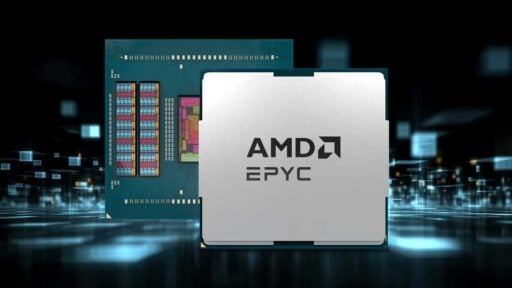

Recent industry data from 2025 indicates a shift in the competitive landscape of cloud computing. While Intel has historically maintained a dominant market share in data center processors, AMD EPYC™ processors have seen increased adoption across major cloud service providers (CSPs), including AWS, Google Cloud, Microsoft Azure, and Oracle Cloud Infrastructure (OCI).
This transition reflects a change in how hyperscalers evaluate hardware, moving toward a diversified “multi-vendor” strategy to optimize for specific workloads.
Table of Contents:
Comparative Performance and Efficiency
The increased adoption of 5th Gen AMD EPYC CPUs is largely attributed to three primary metrics:
- Compute Throughput: Benchmarks for x86-based computing show AMD currently holding competitive leads in multi-threaded performance.
- Total Cost of Ownership (TCO): High core counts per socket allow providers to offer instances that may provide better price-performance ratios for specific high-density workloads.
- Power Density: As data centers face increasing energy constraints due to AI demands, the performance-per-watt metrics of newer architectures have become a primary factor in hardware selection.
Provider Integration Breakdown
Major providers have integrated these processors into specialized instance types to target different market segments:
| Cloud Provider | Instance / Service | Stated Objective |
| AWS | C8a and X8a | Targets high-performance x86 compute requirements. |
| Google Cloud | C4 / N4 series | Focuses on price-performance optimization for web-serving and general-purpose apps. |
| Microsoft Azure | HBv5 VMs | Optimized for High-Performance Computing (HPC) with high memory bandwidth. |
| Oracle (OCI) | Exadata X10M | Utilizes high core counts to improve database processing speeds. |
Key Technical Developments
Industry analysts point to three specific areas where AMD’s architecture has gained traction:
- Hardware-Based Security: The use of Secure Encrypted Virtualization (SEV) allows for confidential computing, encrypting data in use within the RAM. This is increasingly a requirement for highly regulated sectors like finance and healthcare.
- Specialized Workloads: In sectors such as Electronic Design Automation (EDA), AWS reports significant performance scaling, which reduces the “time-to-market” for semiconductor design.
- Memory Architecture: Azure’s implementation of high memory bandwidth is designed to address bottlenecks in complex simulations, such as fluid dynamics and weather forecasting.
The Evolving Landscape
The “Intel-only” era of cloud computing has transitioned into a more fragmented and competitive market. While AMD has established itself as a leader in high-end x86 performance and efficiency, the market continues to evolve with the rise of ARM-based custom silicon (such as AWS Graviton and Google Axion) and Intel’s own renewed roadmap with their “Emerald Rapids” and “Granite Rapids” architectures.
For businesses and developers, the current environment offers more choices than ever, requiring a workload-specific analysis to determine which processor architecture provides the best ROI for their specific needs.