If you are leading an IT team across GCC (Gulf Cooperation Council) and MENA (Middle East and North Africa), you’ve seen challenges unlike anything. The infrastructure hurdles already put your need for digital growth out of balance.
On top of that, navigating complex regional data sovereignty regulations forces you to resort to extreme risk management tactics.
Now, would you want your trustworthy IT infrastructure that you’ve relied on for a decade to suddenly strip you of that perpetual licensing, especially when your needs are at their peak?
No, right? That’s what many IT teams and enterprises are suffering after the Broadcom acquisition of VMware.
VMware, which almost had a monopoly in the market for IT infrastructure, no longer supports perpetual licensing, which brings many IT teams across GCC and MENA to ask one question: Is VMware still worth it? For many, the answer is no. So, are there worthy VMware alternatives in the Middle East to try out?
Let’s look at what actually makes sense for Middle East enterprises.
Table of Contents:
Why Middle East Businesses Are Moving On
Rising costs are the obvious trigger. But there’s more underneath.
Data sovereignty is a genuine priority across the UAE, Saudi Arabia, Qatar, and Kuwait. Industries that are under strict regulation, such as banking, governments, and healthcare, for instance, need workloads hosted in-country. The need is here of an infrastructure that’s auditable locally and is free from the external dependencies on the cloud.
Regulated industries such as banking, healthcare, and government need workloads hosted in-country, auditable locally, and free from external cloud dependencies. VMware’s direction doesn’t always fit that picture.
There’s also the hybrid infrastructure reality. Most enterprises here aren’t fully cloud-native. They’re running on-premise workloads alongside private cloud setups, and they need a virtualization platform that works with that, not against it.
| Why are Middle East businesses replacing VMware?
Middle East enterprises are shifting to VMware alternatives like Sangfor HCI and Nutanix AHV due to the licensing cost increase after Broadcom acquired VMware. With perpetual licensing model abolished, it gets difficult to achieve data sovereignty requirements. Plus, most enterprises in the Middle East seek flexible hybrid infrastructures, which is also the reason for the shift. |
What to Look for in VMware Alternatives?
Before jumping to product names, here’s what to evaluate:
- Workload compatibility and migration tooling
- High availability, live migration, and disaster recovery
- Integrated Threat Detection and security, not an afterthought
- Total cost of ownership, not just licensing sticker price
- Local partner availability in your country
That last point matters more than most vendors admit. A platform with no certified implementation partners in Saudi Arabia or the UAE is a risk you don’t want mid-migration.
Best VMware Alternatives to Consider
| Which are the top VMware alternatives for Middle East enterprises?
The best VMware alternatives for the Middle East are Sangfor HCI, Nutanix AHV, Proxmox VE and Microsoft Hyper-V, each suited to different infrastructure needs and team capabilities. |
Sangfor HCI
IT teams across the Middle East require more than a vendor that solves their IT infrastructure needs. They want a vendor that protects their data sovereignty needs, provides them with hybrid and on-prem deployment, and support. Most importantly, they don’t want a vendor with licensing complexities.
Thankfully, Sangfor HCI solves all of these issues. It delivers the best HCI stack by integrating compute, storage, and networking.
Sangfor HCI, as a virtualization software, combines compute, storage, networking, and a built-in security system. Plus, Sangfor is competitively priced and backed up by regional partner networks.
Does Sangfor HCI Support Threat Detection Capabilities?
Aside from the integrated security of aSEC, Sangfor supports advanced threat detection through a security stack of its own. For organizations driving critical infrastructure digital transformation, the integrated security model alone separates it from most alternatives. You’re not stitching together separate tools. It’s all there.
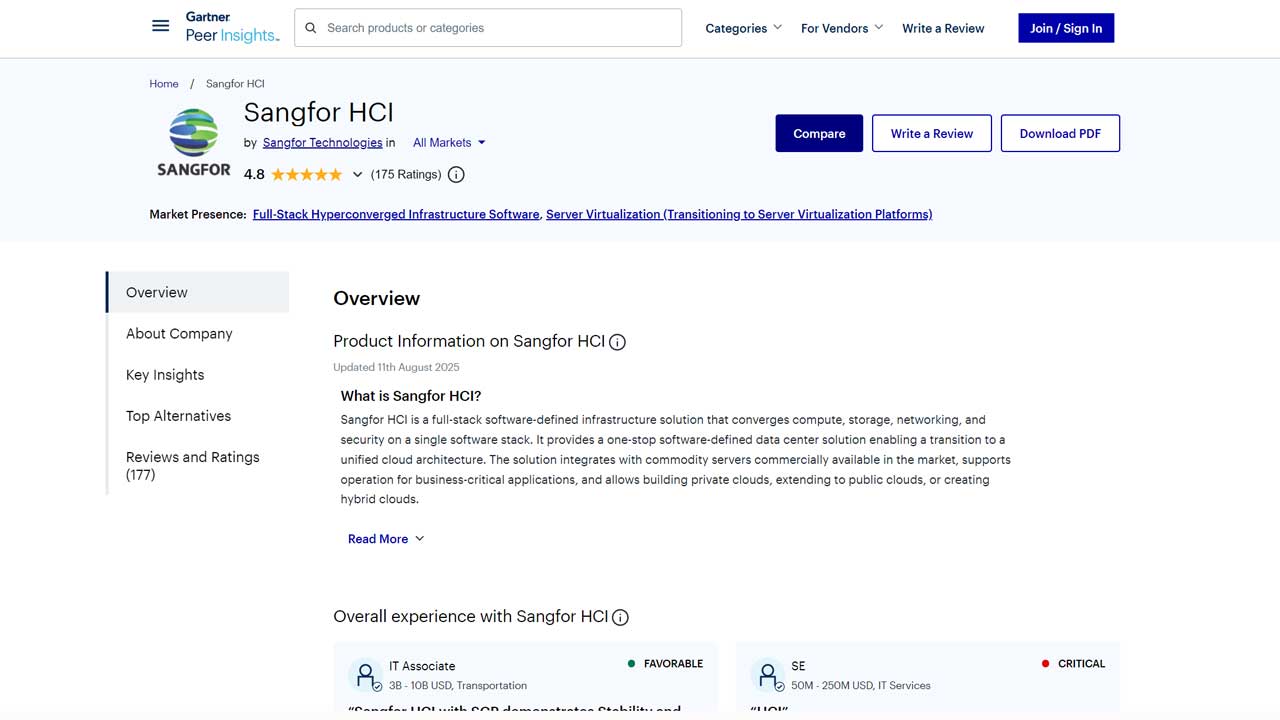
Sangfor is recognized as a Representative Vendor in the 2025 Gartner Market Guide for Hyperconverged Infrastructure. They have racked up a 4.8-star rating on Gartner, along with consistent peer reviews on G2 for ease of use and support quality. That’s not marketing, that’s real peer validation.
Enterprises across Bahrain adopted Sangfor HCI to unify compute, storage, and security, achieving lower TCO, simplified management, and scalable digital transformation outcomes. One such example would be Multinet Trust Exchange LLC. They were using traditional IT infrastructure until switching to Sangfor.
Once upgraded, they got rid of server failures, built IT resilience, and in-country disaster recovery.
Best for: Large enterprises, MSPs, and organizations modernizing private cloud infrastructure across GCC and MENA.
Proxmox VE
Proxmox VE is a powerful, open-source, and genuinely low-cost KVM-based IT infrastructure. It supports LXC containers with a clean web interface. Especially teams that are tech-savvy in nature are going to enjoy this platform. SMEs are comfortable without vendor hand-holding; it’s a strong pick. You’ll need internal expertise; enterprise support isn’t included by default.
Best for: Cost-sensitive SMEs and IT-mature teams comfortable with open-source tooling.
Microsoft Hyper-V
If your environment already runs heavily on Windows Server, Active Directory, and the broader Microsoft stack, Hyper-V is a natural extension. The learning curve is low for Microsoft-certified teams, and it’s included with Windows Server licensing.
Best for: Microsoft-centric organizations with existing Windows Server investment.
Nutanix AHV
Nutanix built its reputation on hyperconverged infrastructure. AHV is their native hypervisor, well-integrated, simplified to manage, and solid for private cloud modernization. Pricing has been competitive in regional deals lately. Worth a serious look if you’re evaluating alongside the broader Nutanix stack.
Best for: Large enterprises pursuing private cloud modernization.
OpenStack
Not for most enterprise IT teams, but important for the right use cases. OpenStack is what large service providers and telecoms use when they need sovereign, highly customizable cloud infrastructure. Powerful, but operationally demanding.
Best for: Large MSPs, telecoms, and government sovereign cloud projects.
Best Fit by Business Type
| Business Profile | Recommended Platform |
| SMEs | Sangfor HCI, Proxmox VE, Hyper-V |
| Large enterprises | Sangfor HCI, Nutanix AHV, HPE Morpheus |
| Cloud providers / MSPs | Sangfor HCI, OpenStack, Proxmox VE |
| Oracle-centric orgs | Oracle Virtualization |
| Microsoft-centric orgs | Hyper-V |
Migration Challenges You Should Plan For
Switching hypervisors is never as clean as vendors make it sound. A few realities:
VM conversion and workload validation take longer than estimated; budget 2–3x your initial timeline. Downtime planning in 24/7 environments is politically difficult, so pilot during off-hours with rollback procedures ready.
Skill gaps are real; your team may know vSphere deeply, but have zero hours on the new platform. Backup, monitoring, and DR all need redesigning from scratch.
| What are the biggest migration challenges when leaving VMware in the Middle East?
VM workload conversion, downtime planning, skill gaps on new platforms, and redesigning backup and disaster recovery workflows are the most common challenges teams face during VMware migration. |
How to Pick the Right One
Start with workload criticality. Evaluate what’s running, and what breaks if migration goes wrong? That shapes your risk tolerance more than any feature comparison.
Do your math. Match the current skill stack of your team and the platform you’re about to migrate to. The spec sheet, and the brochures aside, the best HCI vendor is the one that doesn’t put your team through skill improvement uphill.
The licensing must be transparent, the HCI stack must meet your business requirements, and the pilot must be easy.
Next, look at the total cost of ownership, migration effort, training, support, and any hardware changes, not just the licensing number.
Pilot with one business unit first. Run it in production for 30–60 days before committing to the full environment. Sangfor HCI is among the most reliable VMware competitors for Middle Eastern IT teams.
Aside from all the upsides against VMware, Sangfor also helps with guided migration. Therefore, you can expect smooth pilot projects and be able to make decisions faster without putting your workflow at standby.
Evaluate Beyond Costs
It’s a strategic move to replace VMware infrastructure in today’s day and age. But the decision has to be precise, and the considerations must involve more than simply the pricing. Think of what your IT team needs, their current skillsets, and tie it up with a vendor that meets your regional requirements.
That’s why most enterprises in the Middle East are opting for Sangfor HCI. Its competitive pricing, integrated security, regional partner support, and Gartner-recognized credibility make it the most worth choosing IT infrastructure out there. For cost-sensitive or open-source-ready teams, Proxmox VE works. Microsoft shops fit naturally with Hyper-V. Large-scale cloud buildouts belong on OpenStack.
The right choice depends on your company size, IT maturity, and infrastructure goals three years from now.